As technology evolves, it is becoming harder and harder for parents to regulate what their children are exposed to. This is a very interesting part of my paper about video game regulation and why it is so controversial. The dilemma is that the government regulating these games make some parents feel like the government is violating their role to make choices for their children. But at the same time, for many parents, it is hard to really control what there kids are exposed to, especially if government makes violent video games easily available.
There are many scientific studies that link playing violent video games to stunted social and psychological development. (look to my previous post for more details) With this in mind, many compare the regulation of violent video games to the regulation of cigarettes, where the harm is too clear to leave to the discretion of parents. But, since the harm is less quantifiable or tangible for violent video games, regulating them is more controversial and complicated.
As the Entertainment Merchants Association believes, "Parents are looking for help. They are not looking for government to tell them what's 'right' for their children and what's 'wrong.'" (EMA fyi) So as you can see, many believe that the government should let parents make their own decisions.
Sunday, April 29, 2012

Wednesday, April 25, 2012
Is Stunted Social Development Worth Our Civil Liberties?
Earlier this year, as I am sure many of you remember (in agony), we wrote a paper on civil liberties in war time. Now there were certainly the extremes on both sides, but most of you probably wrote that it was acceptable to violate civil liberties for the sake of national security. Well, my junior theme has made me revisit this very topic only it is a little different this time. I am exploring why video game regulation is so controversial.
 Just to give some brief background information, the current state is that video games are completely self regulated. There are ratings and some stores do enforce them, however technically speaking, it is your constitutional right to buy games like Call of Duty, Grand Theft Auto and even a game like Postal (where you can corpses on fire, mutilate/decapitate other players etc.) even if you are, say 12 years old. It is similar to the way some coffee shops don't serve caffeinated beverages to particularly young children, parents are advised about the risks, venders are told to use discretion, but at the end of the day, it is your first amendment right to buy that product. There have been 9 separate attempts to change this, but every time, the supreme court has deemed regulating video games unconstitutional.
Now, back to civil liberties. The reason so many states want to regulate these games is that recent studies show that exposure to violent video games certainly causes adolescents to feel more aggressive and less sensitive and in some cases, could cause adolescents to act more aggressively. Take a look at this summary from the American Psychological Association of the more important studies regarding violent video game exposure over the past decade. But its not that simple, the studies do not prove that violent video game cause adolescents to ACT aggressively, they only prove that adolescents tend to FEEL more aggressive after playing them. And Many aren't sympathetic to kids feeling aggressive enough to give up essential liberties.
Surprisingly, even with this research however, not one single case out of nine has resulted in allowing lawmakers to abridge Civil Liberties. What do you think? Do you think the scientific findings of the past decade pose a legitimate threat to American citizens and merit the regulation of violent video game sales to minors?
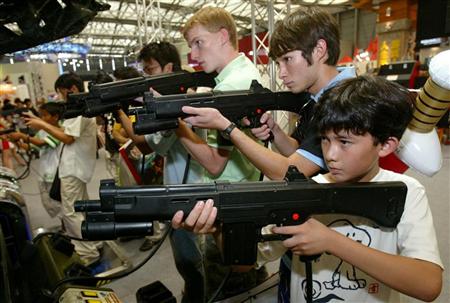 Just to give some brief background information, the current state is that video games are completely self regulated. There are ratings and some stores do enforce them, however technically speaking, it is your constitutional right to buy games like Call of Duty, Grand Theft Auto and even a game like Postal (where you can corpses on fire, mutilate/decapitate other players etc.) even if you are, say 12 years old. It is similar to the way some coffee shops don't serve caffeinated beverages to particularly young children, parents are advised about the risks, venders are told to use discretion, but at the end of the day, it is your first amendment right to buy that product. There have been 9 separate attempts to change this, but every time, the supreme court has deemed regulating video games unconstitutional.
Now, back to civil liberties. The reason so many states want to regulate these games is that recent studies show that exposure to violent video games certainly causes adolescents to feel more aggressive and less sensitive and in some cases, could cause adolescents to act more aggressively. Take a look at this summary from the American Psychological Association of the more important studies regarding violent video game exposure over the past decade. But its not that simple, the studies do not prove that violent video game cause adolescents to ACT aggressively, they only prove that adolescents tend to FEEL more aggressive after playing them. And Many aren't sympathetic to kids feeling aggressive enough to give up essential liberties.
Surprisingly, even with this research however, not one single case out of nine has resulted in allowing lawmakers to abridge Civil Liberties. What do you think? Do you think the scientific findings of the past decade pose a legitimate threat to American citizens and merit the regulation of violent video game sales to minors?
Sunday, April 1, 2012
Has Music Become White Noise?

This is actually a big component of my junior theme topic in which I will try to explain why so few young people listen to jazz. I think Jazz is dead in part because it really can't be used as white noise. I think good jazz commands attention making it hard to focus on anything else while listening to it. Thus people turn to music that will wash over them without distracting them from a seperate activity.
It seems to me that people rarely really sit down and pay attention to what's coming through their ipods. Music is mostly in the background, playing while "listeners" study or work out or drive.
 This might account for why popular music, especially lyrics has devolved. Given the purpose it serves, it wouldn't make sense for modern popular music to have compelling and poetic lyrics like those of the Frank Sinatra song, "The Way You Look Tonight" shown in the picture to the right. Rather, generic and meaningless lyrics that wash over listeners without grasping any attention like those of the Justin Bieber song "Baby" make more sense. People don't look to music for primary entertainment anymore but rather as background white noise or "muzak".
Subscribe to:
Comments (Atom)